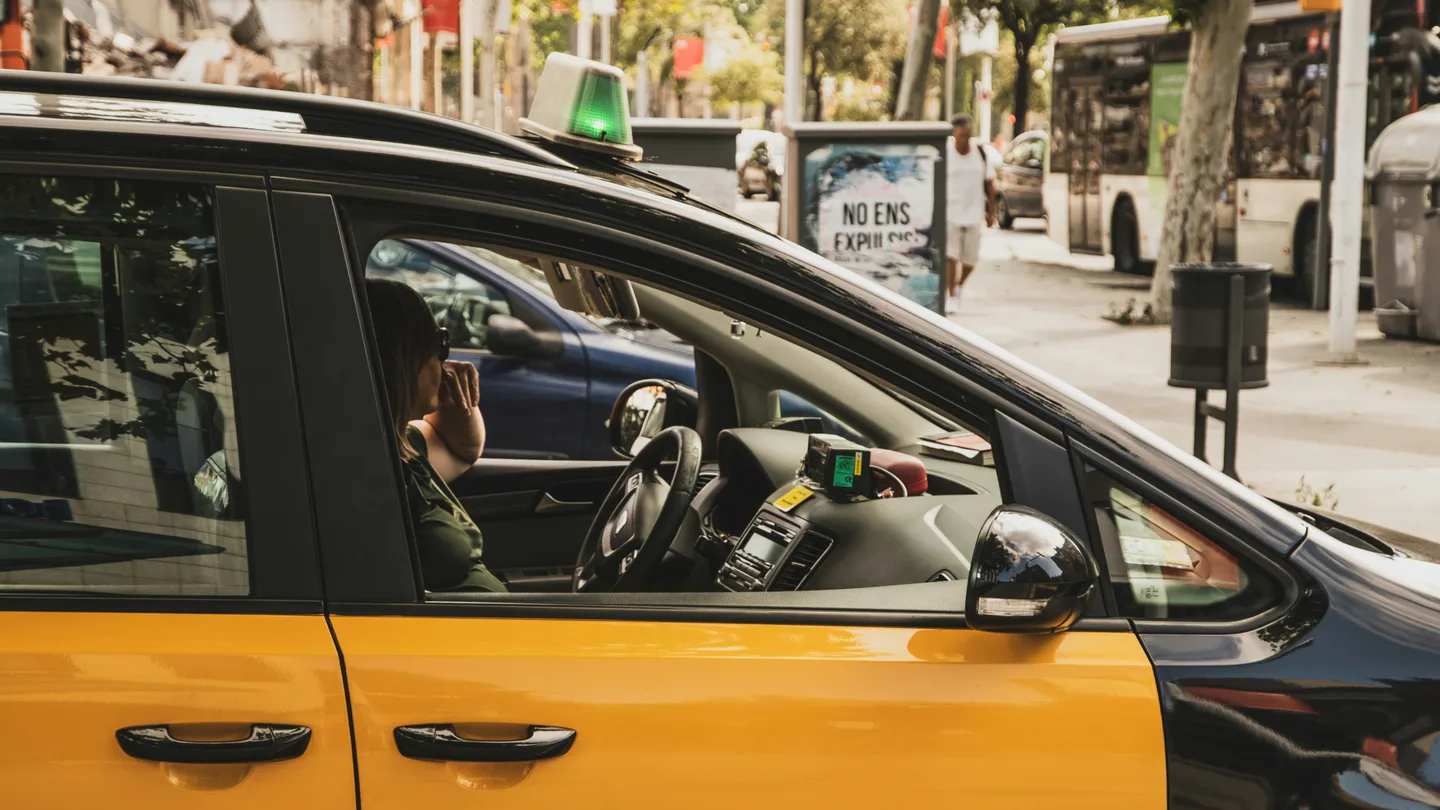
Spain’s VTC and taxi tension meets the visitor trust moment
Spain’s licensed transport rules, pirate-taxi reports, VTC conflicts and visitor-trust warnings all point toward the same question: who can prove the real-world ride?
May 11, 2026·7 min read·Spain
SPAIN · ES
REF SPAIN-VTC-TOURISM · 2026-05-11
POPULATION
48.9 million2026 · UN WPP 2024 / INE Spain cross-check recommended
INT'L ARRIVALS
93.8 million tourists2024 · INE FRONTUR 2024
DRIVER COUNT
~100,000-130,000 taxi and VTC driverslatest available
Spain is not a small tourism market with a taxi side issue.
It is one of the world’s largest visitor economies, and every visitor journey depends on local transport working properly. The airport taxi, the hotel pickup, the late-night ride, the booked through an app and the official city taxi all become part of the same public trust chain.
That is why Spain matters for SafetyRide.
The question is not whether Spain has taxis, platforms or regulation. It clearly has all three. The deeper question is whether the physical ride can be trusted and proven when the transport chain becomes unclear.
Tourism Turns Local Transport Into Destination Infrastructure
Spain reached a new tourism record in 2025. The Spanish Government reported 96.8 million international tourist arrivals and €134.7 billion in international tourist spending by the end of the year.
That scale changes the meaning of local transport.
A taxi or VTC ride is not only a private trip between two points. For a visitor, it can be the first impression of the country, the transfer between airport and hotel, the safe return after dinner, or the link between tourism, hospitality and nightlife.
In a market this large, transport trust is part of destination trust.
If the visitor cannot clearly understand whether the vehicle is licensed, whether the driver is legitimate, whether the pickup is official or whether the fare and route can later be challenged, the issue becomes bigger than one trip.
Spain Already Warns Visitors About Unlicensed Transport
The United Kingdom’s official Spain travel advice gives unusually direct taxi guidance. It tells travellers to use official registered or licensed taxis, or reputable transport companies they recognise. It also warns that passengers caught using unlicensed taxi services are liable for fines of up to €600.
That is a strong signal.
The warning is not only aimed at drivers. It also places a burden on passengers, especially tourists, to make the correct transport choice in an unfamiliar environment.
The advice makes sense. Visitors should avoid unlicensed transport. But it also shows the practical weakness of the current model: the passenger is still expected to identify legitimacy at the moment of pickup.
That is exactly where a physical verification layer can help.
A sign, licence, app booking or coloured number plate may all be useful. But the passenger still needs confidence that the vehicle, driver and ride event match the legitimate transport relationship.
Barcelona Shows the Street-Level Problem
The official warning becomes more concrete when it is compared with local reporting.
ARA reported in November 2025 on pirate taxi drivers in Barcelona targeting tourists returning from nightclubs along the seafront promenade. The reporting described drivers ignoring regulations, picking up customers outside the proper system, charging whatever fares they wanted and ignoring the taximeter. It also pointed to why visitors are exposed: unfamiliarity with the city, alcohol, night-time travel and uncertainty about how local taxis operate.
This is exactly the kind of story that should be used carefully. It should not be framed as “Barcelona taxis are unsafe”. It should be framed as a visitor-trust signal: when the passenger cannot easily tell whether the ride is legitimate, the market needs better proof at the point of pickup.
That distinction matters because a few bad actors can damage trust in an entire destination. If visitors repeatedly hear about pirate taxis, unlicensed offers or airport confusion, the effect spreads beyond the individual scam. It can create suspicion toward legitimate taxi drivers, VTC operators and local businesses that rely on visitors feeling safe.
Documented transport should make it much harder for illegal actors to exploit travellers arriving with open minds and limited knowledge of local rules. The purpose is not to stigmatise Spain’s transport market. It is to protect the serious actors from being judged by the behaviour of the few.
The Taxi and VTC Debate Is About More Than Competition
Spain’s taxi and VTC debate is often described as taxi versus platform.
That is too simple.
In , proposed taxi legislation has been framed around taxis as an economic service of general interest, while VTCs are treated as complementary private services. Catalan News reported that the new law would gradually reduce the number of ride-hailing services across Barcelona’s metropolitan area as licences expire.
The VTC sector has pushed back strongly. In March 2026, El País reported that VTC associations and Feneval had asked the European Commission to intervene against Catalonia’s proposed “anti-Uber” taxi law, arguing that it discriminated against the sector, ignored EU law and could lead to progressive elimination of urban VTC activity in areas such as Barcelona.
This is not only a fight over apps.
It is a fight over who controls the transport market: taxi licensing, VTC access, pre-booking rules, geolocation, labour, service availability and the passenger interface.
For SafetyRide, the important question is not which side wins. The important question is what happens to trust when the market is fragmented between local taxi rules, VTC platforms, airport needs and visitor expectations.
The same conflict is not limited to Barcelona. In the Balearic Islands, the taxi and VTC debate has also become a regional pressure point. Local reporting from Ibiza and Mallorca has described concern over large numbers of VTC licence applications, taxi-sector anxiety about the impact of VTCs and seasonal licences, and legal disputes after courts ordered parts of earlier licence-denial processes to be reassessed. Cadena SER reported in January 2026 that Balearic authorities were working on new rules as a moratorium expired, with around 10,000 new VTC licence applications in process and 6,500 in Ibiza alone.
For a visitor market built around islands, airports, nightlife and seasonal demand, that matters. If supply, licensing and pickup rules are unclear, the trust problem becomes physical very quickly: who is allowed to pick up, where, under which service model, and with what evidence?
Regulation Needs Evidence, Not Only Rules
Spain’s regulatory debate shows that rules alone do not solve every trust problem.
If a VTC must be pre-booked, someone still needs to know whether the physical ride matched the booking. If a taxi has regulated fares, someone still needs to know whether the correct vehicle and route were used. If geolocation or location-based rules are introduced to detect irregularities, the system still depends on trusted event data.
That is the difference between regulation and proof.
Regulation says what should happen. Proof helps establish what did happen.
Spain’s market needs both.
A tourism-heavy city cannot depend only on the visitor recognising legitimate transport. A driver should not be exposed to false claims without evidence. A taxi operator should not be undermined by illegal transport. A VTC operator should not be trapped in unclear rules without a reliable record. A regulator should not have to reconstruct the ride after the fact from incomplete data.
The Airport and Hotel Handoff Is the Weak Point
The weakest moment is often not inside the app. It is at the handoff.
A visitor exits an airport. A driver offers help. A hotel books a car. A passenger follows a sign. A group leaves a nightclub. Someone uses a messaging app or informal contact. The traveller may not know the local rules. The driver may be legitimate, or not. The price may be fair, or not. The ride may be insured, or not.
The problem is not that Spain is unsafe. The problem is that tourism transport depends on many small trust decisions made quickly by people who may not know the market.
That is why unlicensed transport warnings matter. They show that the physical ride remains the point where policy, enforcement, visitor behaviour and market trust meet.
The Missing Layer Is the Verified Ride
Spain already has taxis, VTC platforms, airport flows, visitor guidance, regulated fares, licensing systems and political debate.
What it still needs is a stronger neutral evidence layer around the ride itself.
Who was the driver? Which vehicle was used? Was the ride licensed? Was it pre-booked where required? Did pickup happen at the correct place? Was the route reasonable? Was the fare connected to the proper system? What evidence exists if the passenger, driver, operator, hotel, insurer or regulator later needs to understand the event?
A documented ride event should make that clear before doubt becomes a dispute.
Where SafetyRide fits
SafetyRide belongs in Spain by making the taxi, VTC, hotel or airport handoff clearer before the visitor enters the ride. It supports lawful transport choices in a market where category distinctions matter.
Continue
Read more from SafetyRide.
Browse the rest of the articles, or get in touch about anything you read here.