MOROCCO · MA
REF MOROCCO-TAXI-REFORM · 2026-05-11
POPULATION
38.4 million2026 · UN WPP 2024 projection
INT'L ARRIVALS
17.4 million tourists2024 · Moroccan Ministry of Tourism 2024 reporting
DRIVER COUNT
~80,000-120,000 taxi driverslatest available
— Market research
Morocco is rethinking taxis and ride-hailing, but the real challenge is proving the handoff, not choosing sides.
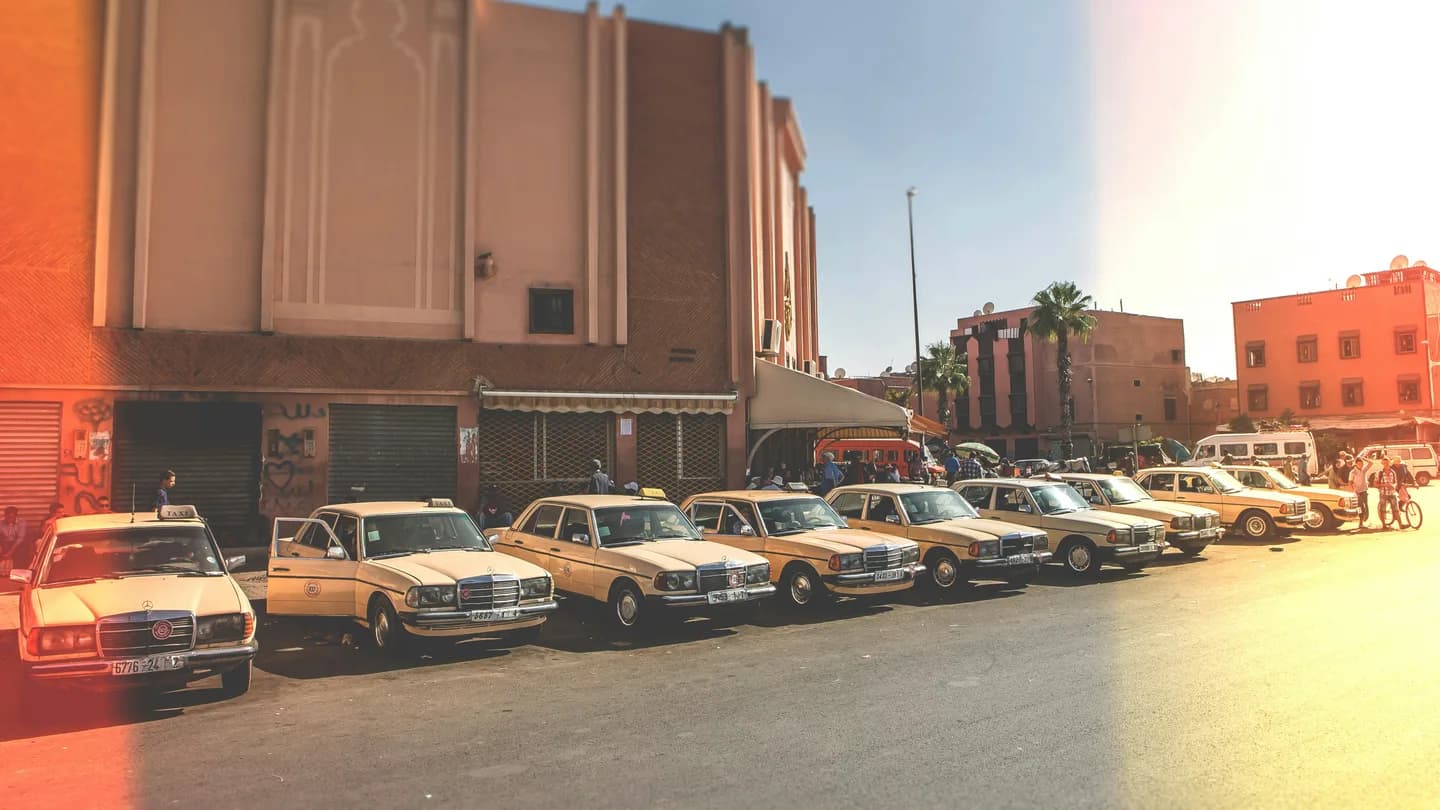
A transport market does not become modern simply because an app appears. It becomes trustworthy when passengers, drivers, operators and authorities can prove what actually happened.
That is the real lesson in Morocco’s taxi and ride-hailing debate. The country is not facing a simple choice between traditional taxis and digital mobility. It is asking how a high-visibility visitor destination can modernize transport without weakening legal status, driver livelihoods, passenger confidence or destination trust.
That makes the serious-operator angle important. SafetyRide should not present Moroccan taxis, drivers or local operators as the problem. The more useful question is how responsible actors can become easier to identify, verify and protect when informal offers, legal grey zones or unclear pickup moments create doubt.
For visitors, Morocco’s transport experience often begins at an airport exit, hotel entrance or city curb. The Moroccan National Tourist Office explains that travellers can use shuttle buses, taxis or car rental agencies when leaving airports, and that taxis are common in Moroccan cities.
That sounds simple. In practice, the handoff is where trust becomes physical. The visitor may not know the local taxi colours, the normal price range, whether a driver is licensed, or whether an app-based offer is legally recognized.
When everything works, this is invisible. When trust fails, everyone needs better evidence.
Recent public reporting shows that Morocco’s taxi sector is under real reform pressure. Interior Minister Abdelouafi Laftit told parliament that authorities recorded around 5,000 taxi-driver violations in 2025, with more than 1,500 professional licences temporarily or permanently suspended.
The same reporting describes roughly 77,200 taxis and about 180,000 drivers. Laftit also acknowledged passenger dissatisfaction, legal gaps, overlapping authorities, slow adoption of mobile apps and GPS, and unlicensed ride-hailing. That is why the debate cannot be reduced to “apps good” or “taxis bad”. Morocco needs modernization, but it has to protect people who carry operational responsibility.
Ride-hailing has remained difficult to place inside Morocco’s current legal framework. Morocco World News reported that Uber left the country in 2018 after protests and the lack of a clear operating framework. Later app-based services continued to operate in a legal grey zone, used by passengers but not fully recognized by authorities.
Yabiladi reported that the Ministry of Transport and Logistics denied blocking licences, while explaining that current Moroccan road passenger transport laws do not include specific provisions for ride-hailing services. The ministry also noted that urban transport falls under the remit of the , and recalled that passenger transport without legal authorization is treated as illegal activity.
That kind of grey zone is bad for passengers, because protections are unclear. It is bad for drivers, because their legal status and income are uncertain. It is bad for licensed taxi operators, because competition may not follow the same rules.
Most importantly, it weakens the proof chain. If the market cannot connect the legal category, driver, vehicle, pickup, route, fare context and incident record, disputes become harder to resolve and serious operators are easier to undercut.
Morocco’s debate also has a driver-economics layer. Reporting on planned app-driver strikes in 2025 described drivers calling for legal reform, complaining about low fares, platform dominance and commission levels that could exceed 25 percent. The same reporting used the term as part of the demand for a clearer legal category.
The presence of terms such as shows that this is also about market access, compliance costs, customer control and accountability when something goes wrong.
A fair market needs more than entry checks. It also needs a record around the ride that creates the revenue. If the driver, vehicle, fare logic, pickup and platform role are unclear, the economic event is unclear too.
Morocco should not be portrayed as unsafe, weak or in need of outside rescue. It is a major destination with established local transport systems, a large professional taxi workforce and active public debate about modernization.
The problem is more specific. A small minority of bad actors can damage trust far beyond the individual incident. A few overcharging drivers, illegal operators or unverified pickups can create suspicion toward an entire market, even when most drivers are legitimate and most journeys are normal.
Social media posts and traveller stories about taxi overcharging or airport confusion should not be treated as hard statistical evidence. They are perception signals. But perception matters in tourism. When the market lacks proof, honest professionals can be judged by stories created by the few.
Morocco’s policy debate is moving in the right direction by recognizing that app-based mobility cannot simply be ignored. But legalization, enforcement and taxi modernization will still need a stronger evidence layer.
A taxi permit proves that someone is allowed to operate. An app record can show that a ride was requested. A fare rule can define the expected price. A complaint system can record what someone says later. None of these alone proves the full physical event.
The missing layer is a neutral way to document the handoff: who was driving, which vehicle arrived, where the passenger entered, what route was taken, what fare context applied, and what happened if the trip became disputed.
That is the difference between regulating transport categories and proving transport reality.
SafetyRide belongs in Morocco by making reform and operator identity visible in daily use. It can help serious taxis, airports and tourism partners create a clearer handoff without replacing Moroccan transport structures.
Browse the rest of the articles, or get in touch about anything you read here.