France’s regulated taxi market still needs pickup clarity
France has detailed taxi and VTC rules, fixed airport taxi fares, and a national taxi availability register. The remaining trust gap is proving the real vehicle, driver and pickup at the moment a traveller accepts a ride.
May 11, 2026·5 min read·France
FRANCE · FR
REF FRANCE-TAXI-PROOF · 2026-05-11
POPULATION
66.7 million metropolitan / ~68.6 million including overseas territories2026 · UN WPP 2024 / INSEE cross-check recommended
INT'L ARRIVALS
~102 million international arrivals2024 · Atout France / French tourism reporting
DRIVER COUNT
~60,000 taxi drivers plus large VTC driver baselatest available
France is not a loose transport market. It has rules, categories, price logic, identification requirements and public digital infrastructure. That is exactly why France is strategically useful for SafetyRide. The issue is not that the market lacks serious actors or regulation. The issue is that serious taxis, authorised , airports and hotels are not always easy enough to distinguish from opportunistic or illegal actors at the exact moment a traveller chooses a car.
For a visitor arriving at Paris Charles de Gaulle, Orly, a railway station or a hotel entrance, the important question is immediate: is this the right vehicle, the right driver and the right trip? France has many answers on paper. The gap is the handoff.
Taxis, VTCs and the distinction at the curb
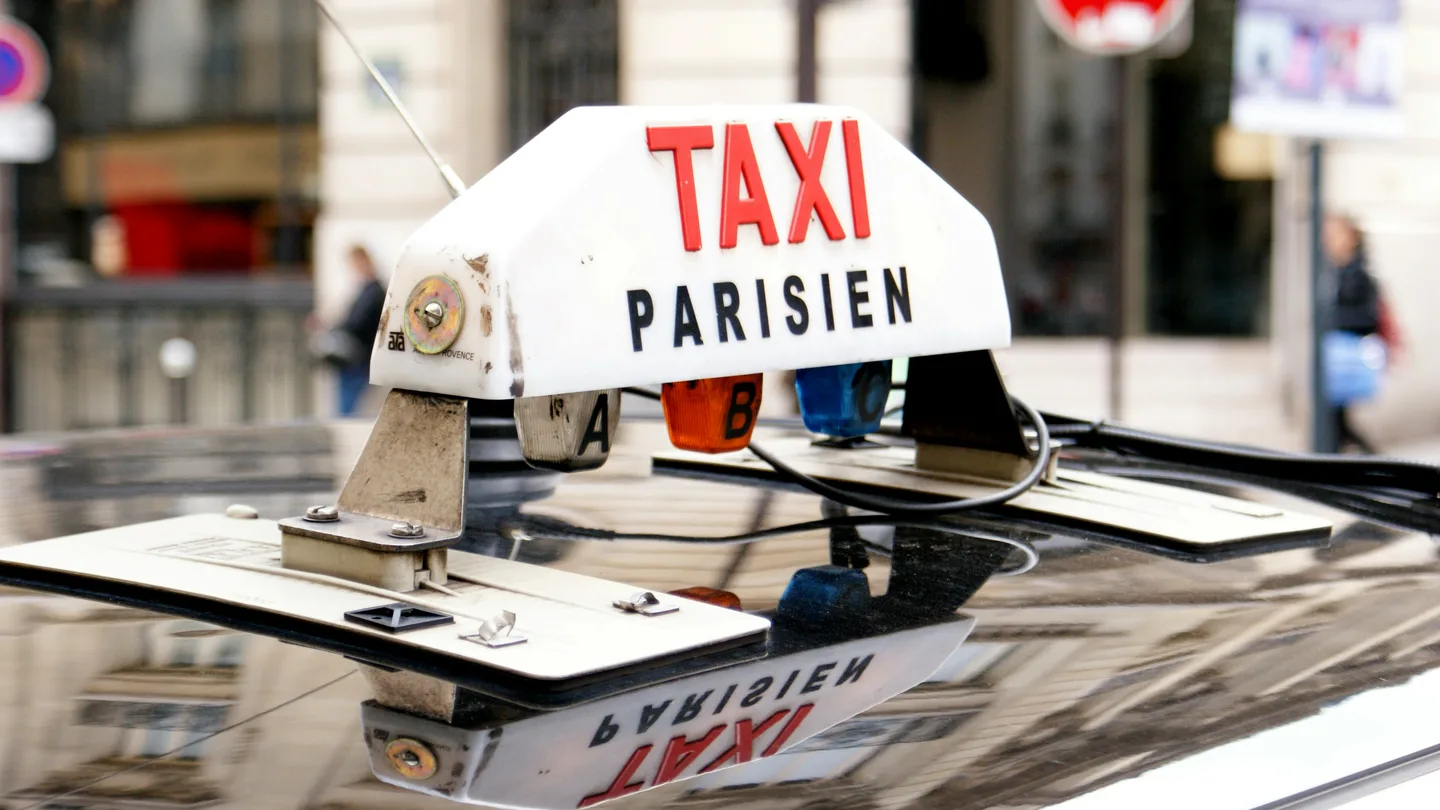
Official consumer guidance explains that French taxis are tied to a parking permit, display a luminous taxi sign, use a taximeter, provide printed fare information and accept card payments. It also warns travellers to beware of fake taxis and says solicitation is prohibited, especially around airports and stations. A VTC, by contrast, must be booked in advance and cannot be hailed in the street or parked in a taxi rank.
That difference matters. Taxis are allowed to serve the street and rank market. VTCs are part of the booked-ride market. Both can be legitimate. Both can be useful. But to an arriving traveller, especially one who does not speak French or know the local signs, the distinction can collapse into a confusing physical scene: people offering rides, signs pointing to taxi ranks, app pickups, hotel transfers and private cars waiting nearby.
Le.Taxi and Paris airport's fixed fares
France has already moved toward digital transport infrastructure. Since December 2021, available taxi drivers have been required to be visible in the national availability register when operating in a pickup zone. That is an important signal. It shows that the French state already recognises taxi availability as a shared data layer, not only a private dispatch matter.
Paris airport pricing also shows how mature the system is. Official French guidance lists flat fares between Paris and the two main airports. For Charles de Gaulle, the rate is set by whether the destination is on the right or left bank. Orly has its own fixed rates. The point is not only price control. The point is predictability. A traveller should not have to negotiate the basic legitimacy of the journey after entering the vehicle.
Illegal taxis and the Paris hub friction
Yet predictable pricing does not automatically create pickup clarity. Local reporting has repeatedly described the same weak point around Roissy-Charles de Gaulle, Paris railway stations and other high-friction pickup locations: unauthorised drivers approaching travellers, inflated fares, illegal solicitation and police action against fake taxis. Le Parisien reported that illegal taxi offences recorded by the specialist taxi police doubled in the first eight months of 2018, with airports representing a large share of the cases. Later reporting described undercover tests at Gare de Lyon and Roissy, a clandestine driver convicted after charging €280 for a Roissy-Paris trip, and police using stronger investigative methods against repeat offenders. In 2023, The Connexion reported arrests linked to an alleged lookout network at Roissy-Charles de Gaulle, where men were suspected of warning illegal taxi drivers about police checks so they could avoid enforcement and overcharge tourists.
That does not mean the French taxi market is broadly unsafe. It means the handoff problem is visible enough to appear in official warnings, local news and traveller forums, and that the serious side of the market benefits when the difference becomes easier to prove. A fake or unauthorised driver can still imitate the context around a legitimate taxi journey. A confused visitor may still be approached before reaching the official rank. A hotel concierge, airport assistant or venue staff member may still lack a simple way to verify whether the passenger reached the authorised pickup process. A complaint after the fact is weaker than a verified handoff before the door closes.
This is where France becomes a strong proof-gap market. The existing rules already define what should be true. The missing layer is a way to make that truth easy to confirm in the physical world.
The same applies to market fairness. France has also been working through the relationship between platforms and VTC drivers. Official sources describe minimum income guarantees for platform VTC drivers, including a net minimum per ride and hourly guarantees. The competition authority has also reviewed collective agreements around driver choice and platform systems. These debates are not only labour questions. They are evidence questions. A fairer market needs reliable records of what was offered, accepted, performed and paid.
An accountability record around licensed transport
SafetyRide should not present itself in France as another booking app. That would be the wrong posture. France already has taxis, VTC platforms, dispatch systems, public registers and strong local rules. The better positioning is a neutral accountability record that helps authorised actors prove what happened.
For a passenger, that means a simpler confirmation before entering the car. For a driver, it means stronger protection against confusion, false claims and disputes. For a taxi association or VTC operator, it means clearer handoff evidence without surrendering the customer relationship to a commission-heavy platform. For an airport, hotel or tourism partner, it means better continuity between arrival, pickup and destination.
France is already trying to make transport trust machine-readable. Le.Taxi is one example. Fare rules are another. Driver identification and taximeter receipts are another. SafetyRide’s opportunity is to connect those ideas to the moment where trust is won or lost: the physical pickup.
Where SafetyRide fits
SafetyRide can support France’s regulated taxi and VTC environment by making the pickup clearer to the passenger. The value is practical recognition around licence, vehicle, location and ride context, not disruption of local rules.
Continue
Read more from SafetyRide.
Browse the rest of the articles, or get in touch about anything you read here.